HUMI-Suva is a project that is deliberately aimed as being a longitudinal study. The initial goal is to collect data for 5 years. Mainly as a settling programme and ensuring that our partners are in fact on-board with our data collection and so on. We think 5 years is a good goal to have regardless, but one never knows if the attempt will work out because of factors outside of our control. Five years seems like a good time frame to iron out kinks if they can be ironed out, however, our ultimate aim is to extend the work beyond to be 35 years.
There are two broad advantages for us as a school to want to do this. The first is to do with the education side of things; the second is the applied science side of things.
The Science Side of Longitudinal Studies

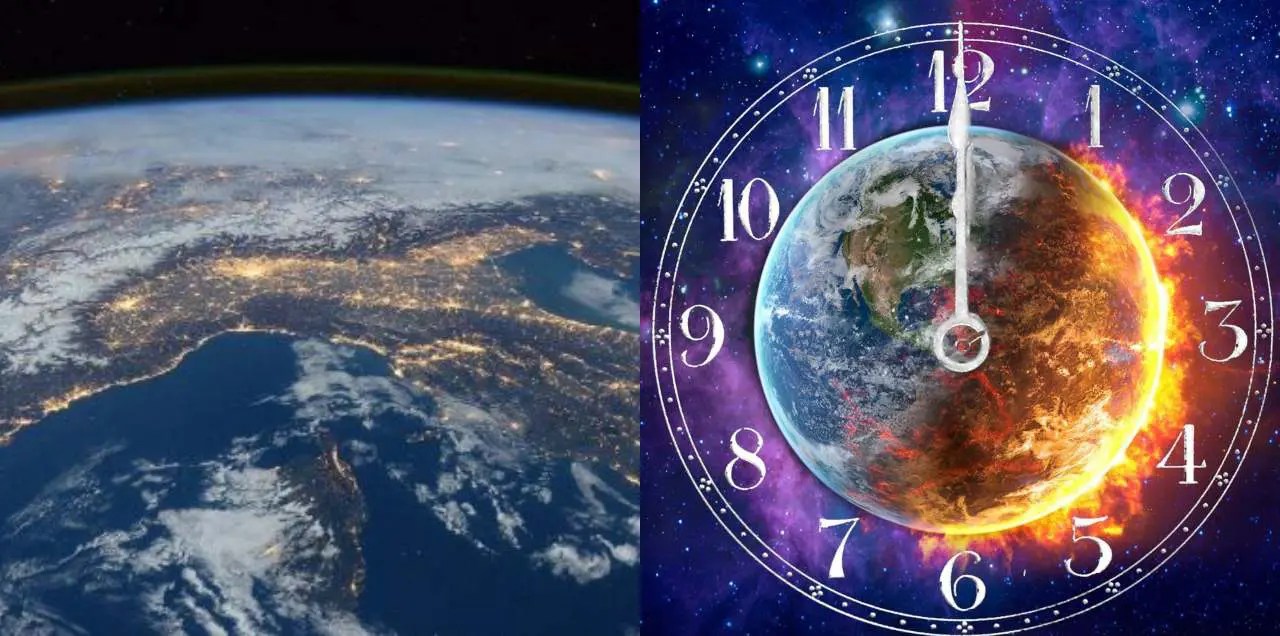
Well to address the elephant in the room, the next 35 years are probably going to be the most eventful 35 years in the last 1,000 years of recorded humanity because of climate change. So the intent is to consider looking at these changes precisely because we anticipate that there will be a great many changes occurring without any particular interventions on our part.
Even if this elephant did not exist, longitudinal studies are believed to be one of the golden standards of observational and/or correlational studies where the science is conducted in real world settings where not every single variable can be controlled for as a conventional experimental study. Normally this brings rather messy data to the mix giving potentially spurious or outlying data that does actually reflect the reality on the ground but it may give the researchers the wrong bias or conclusions based on only a single reading.
Longitudinal studies have a way of ironing out localised data effects and instead one can look at trends. As long as enough time occurs and there are no methodological flaws, then the ironing out of data allows trends to be observed and because the researchers are there on the ground when the data is being collected, there is the opportunity to actually provide more fine detail as to what is going on, in and on the ground to so to speak.
There are other types of longitudinal studies possible where a ‘marker’ is left somewhere to be collected later after a set amount of time. Climate change scientists have been doing this with measuring the composition and thickness of ice layers in drilled ice cores from the Antarctic and Artic to ascertain what the CO2 levels were and correlating that with the apparent global temperature at the time. However, since this is looking back (at many thousands of years) there’s no opportunity to gather additional information on site.
That would suggest that the best longitudinal studies are the ones where there is active data collection at the time AND it takes place over a long period of time. Why not HUMI-Suva? Well we have to start somewhere right?
The Educational Side of Things
How about the educational side of things in undertaking such a project.
- Learning the art of ‘doing’ science rather than learning about facts learned from doing science.
- The ‘science’ is ‘real’, ie there’s a sense of engagement that cannot be easily replicated when say adding vinegar to baking soda in a flask.
- Engagement with the city, provincial or even national stakeholders is possible to demonstrate how emerging citizens can engage with policy makers.
- Despite adding to the data set that gives a new picture every year, there is a familiarity with the process in collecting the data so that the school and its teaching staff can build up genuine expertise in good quality data collection.
Let’s unpack some of these issues in more detail.
Doing Science Rather than Facts & Figures
There’s always been a disconnect between the drive to be ‘teaching’ science disciplines at primary and secondary school, especially now that there is a big push for the STEM disciplines to be promoted; and the actual teaching of science.
The vast majority of information taught in science is about the facts and figures learned by science. There is some information given as to how the facts and figures are learned, normally by engaging in laboratory work.
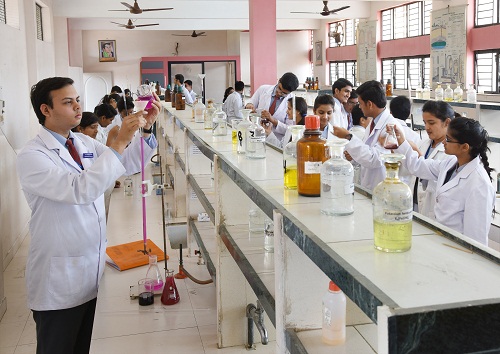
Take secondary school chemistry in most English speaking Anglo-Eurocentric educational curricula. We learn about atomic structure; we learn how this informs how to create and use the Periodic Table; we learn about the basic reactions between metals and non metals (and some in-betweens); we learn about acids and bases and how we can measure pH of solutions; or how to make buffer solutions in aqueous solutions; and then there’s the whole plethora of organic chemistry with naming system of alkanes, alkenes, alcohols, esters, amides etc and their physical and chemical reactions. We can learn about substitution or dehydration or oxidation reactions.
But …
… they are all descriptions.
Science is the process of learning how to understand the world by (keeping it simple here):
- Making observations that are observable by many.
- And where the observations are frequent enough to be observed.
- Science strives for simpler explanations (as it fits in with all knowledge) – parsimony.
- Science more often uses logic to build up a sequence of cause and effects relationships (but not always, sometimes intuitive leaps are made).
- Science normally ends up with a hypothesis or working model about the nature of the world and then this hypothesis is tested – mainly by trying to find flaws in it and replacing it with a newer/better hypothesis.
Where is this taught in secondary school (to say nothing of attempting this in primary school)? Of course the pedagogues would say that there would be too much information to present to school students and first of all they need a basic vocabulary and some base information before we can actually teaching them how to do the actual process of science.
I think we can safely ignore that kind of advice. That is the same logic that stated that one cannot teach science without learning the Classics first, before moving onto a grounding in philosophy before embarking on actually doing science. Now granted there probably are genuine benefits to a scientist taught that way, but it’s definitely NOT the only way to teach science as our current educational systems are clearly showing.
Effectively HUMI-Suva is proposing to learn about how to do science by learning on the job (LoJ) which is actually an old pedagogy called ‘role modelling‘ and before it got this name it was called an apprenticeship. Previously if you wanted to learn to hunt, you went out with a hunter and followed her or him with ‘on the job’ explanations being given during the hunt.
Of course there would be times when a specific skill would be learned such as to how to shoot a bow and arrow but not the exclusion of doing no hunting.
HUMI-Suva is about learning to do science by learning the art whilst learning ‘on the job’.
Engagement with Scientific Enquiry
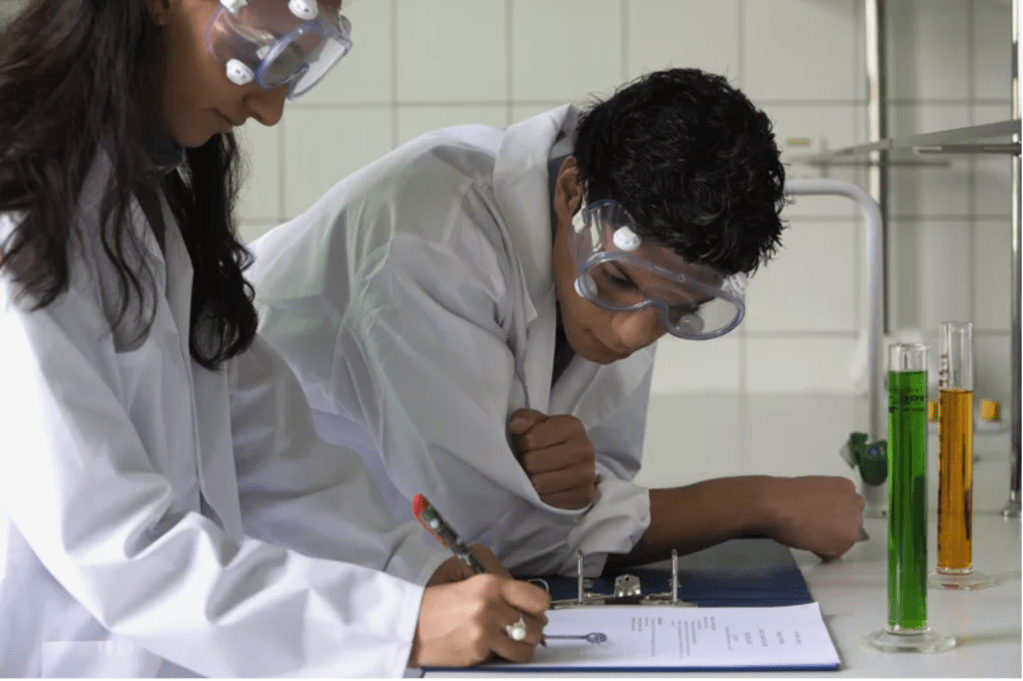
Science students are often asked to do science laboratory sessions such as chemistry, where they would mix chemicals in solutions, write down observations and then take measurements which they write up in their ‘lab books’. I’ve no idea whom the curriculum designers think they are kidding that this makes for engaging learning or science. Often taking place during a double lesson that is between 90-120 minutes, students are ‘managed’ through the process of going through the motions of mixing chemicals, observing and measuring all whilst trying to not have anyone blow up, scald or dissolve the students or their peers or the whole laboratory. The write up is often presented as a set of prompted questions to which the answers are supposed to build up to a ‘report’.
The result is a prepackaged ‘weak’ experience (normally because of genuine OHS concerns) where the students know full well there there is an ‘expected’ answer. This however, is not science – this is just repeating something that someone has already done a long time ago. There’s bound to be some students who enjoy this, but heck there are some students that genuinely enjoy rote learning their times tables. The majority do not, either enjoy doing the science labs, or learning their times tables!
HUMI-Suva though is not pre-digested science. It’s brand new. The techniques may already be established but the ‘answers’ are not already known. The explanation for getting the results that HUMI-Suva will uncover are not known in significant detail. The students will know this because the teachers will be just a ignorant of these details are the students are in any one year.
Working with Relevant Stakeholders
Science education is often taught in schools as a disconnected discipline that does not have much to say about social issues, or policy making. Scientists stick to their ‘silos’ of doing the science and they pass off their information to the policy makers who then decide in the light of this information, how to build infrastructure, or finance health systems, or train up their police forces and firefighters.
Right where they section above says that scientists pass on their information to policy makers, is where there’s often a big disconnect because scientists do like to talk ‘scientifically’. And the idea that a scientists should have no social responsibility to think of the social ramifications of their work has been dramatically called in question by speechers and biographies of luminaries such as Robert Oppenheimer and Albert Einstein in their contributions to making atomic bombs that were dropped on human populations at the end of the second world war in Japan.
HUMI-Suva’s work goes beyond just collecting data and then trying to interpret it at however superficial a level. Its aim is to actually have the students interact with policy makers at the city planning level. Whether the policy makers listen to the information will be a reflection of how well we can present the information that is understandable and relevant. If we don’t at first succeed, then we learn and try again!
We would anticipate that eventually city policy makers might even request that we look at specific sites that they are going to change or do substantial work on or around, to see how this might affect living in those areas. In other words HUMI-Suva is not supposed to remain an exclusive enclave of citizen science with the school; rather the school is a significant contributor towards helping policy makers make Suva a genuinely healthier place to live, with other stakeholders also included such as town and country planners as well as the numerous health clinics that exist around the Suva and Greater Suva area.
HUMI-Suva’s current model is also one in which the ‘real’ scientists are a significant partner. The school may collect and then receive data that they analyse, but that does not mean that they are right. Sharing the HUMI-Suva data with professional scientists means that they get to use the data collected; AND they get to write up their own scientific papers; AND they get to either comment on the school’s interaction with other stakeholders such as policy makers, or they can be joint presenters. HUMI-Suva students will be interacting at some level with the actual scientists that are at the boundaries of knowledge of the biodiversity of the microbiome and human health. It is like being taught how to play a piano by a virtuoso pianist, rather than a piano teacher.
Setting Up & Running HUMI-Suva Becomes Progressively Easier
The great thing about a longitudinal study from a school perspective, is that despite the section above being about running and collecting original data for anyone year; the practical consideration of doing such citizen science projects for non-scientists, is that initially it is a struggle. Conceptually there needs to be a lot of technical and scientific input with local expertise ‘on the ground’ willing and able to implement the ‘doing the science’ part of the curriculum.
A big investment in time, and normally money, to get this right. If this happened very year it would be a huge and debatable drain on a school’s resources unless the teaching staff were all scientists who decided to teach at a school.
If the science though is longitudinal, then suddenly the resource equations and pay offs become very different. Initially, the effort is likely to be difficult, frustrating, expensive and perhaps even ‘wrong’ (as in the data cannot be used by the ‘real’ scientists).
Summary
HUMI-Suva as a longitudinal study has major benefits from a scientific point of view, and from an educational point of view. The scientific point of view is that it show longer term trends and iron out potential ‘freak’ data collection periods where the data collected is not representative to what normally happens. It is also is occurring in what many scientists are beginning to realise is going to be one of the most momentous times of change in recorded history with the spectre of climate change hanging over the globe. From an educational point of view there are at least four main benefits: (i) it teachers how to actually do science; (ii) the scientific details is unknown and therefore will be more engaging than a conventional science lab; (iii) working with stakeholders in the community, in particular professional scientists and Suva city policy makers; (iv) repeating the data collection over the years means that the actual process of doing the HUMI-Suva project becomes easier and cheaper to do over time because we will become more practiced at doing it.
 HUMI Suva