Citizen science has some impressive success stories, where citizens collect data for scientists to analyse, normally under conditions that the scientists could not afford to collect as much data, or collect data from certain locations (or both).
One of the more dramatic ones is the Search for Extraterrestrial Intelligence (SETI). Although it started within NASA as a sort of ‘off time’ project, it essentially could not get the kind of breadth and depth of analysis that NASA could devote to this project. For the most part, the work involves looking for signals in the electro-magnetic spectrum that would indicate deliberate signalling by an intelligence outside of Earth. The problem is to analyse the electro-magnetic ‘noise’ that hits our Earth and then try to shift the background noise out and isolate what are obviously ‘intelligence made’ signals. The signals might be deliberately aimed at us, or they might be ‘leakage’ from things such as radio, or television broadcasts.
One solution to this was to distribute software to citizens who were attached to the internet, and allow their computers to ‘crunch’ data that SETI had gathered, and this would take place late and night and early in the morning, when presumably the computer would not be actively used by the owner assuming that they slept at this time. The programme appears to have gone into hibernation right now, but they are still working through the analyses sent in by all the citizens, but it’s an impressive data set given that it went into operation in 1999.
Other early citizen science projects have included:
In this model the scientists are asking for ‘free’ labour. It is ‘their’ work but hopefully (they reason) it seems interesting or even ‘sexy’ enough that people would want to do it. I am writing this in a way that sounds as if this is a bad thing and I do not think it is. Some people like to help and they like lending their hand at doing things that seem morally worthwhile, or intellectually stimulating; conservation or looking for signs of extra-terrestrial intelligence and they don’t need (or want) any ownership of the data collected to be used in some way that is relevant to the citizen helpers.
Originally when I started to converse with David, Chris and Phil about the HUMI concept, I totally envisaged that we would be part of that kind of citizen science. However, as time has gone on, they’ve gradually changed my mind to think of this as actually being ‘our’ project, that is we the actual citizens collecting the data, have as much right to the data as the research scientists for whom we are collecting the data for.
In particular, I’m struck by the comments that collecting this data might or will (think positive!) help to inform policy and decision makers in the greater Suva area. That is the data can (will Robin – think positive!) show the value of biodiversity in town and urban planning.
Furthermore the idea that this is a long term longitudinal project lends credence to the idea that we are able to contribute greater understanding by charting changes over time and even to do direct interventions to increase biodiversity and compare the effects of those interventions with matched comparable other sites.
This seems to me to be a fundamental shift in perspective. Below I’ve mapped out a traditional ‘citizen science’ perspective.

- Scientists propose a research idea for which they cannot collect (enough) data so they recruit interested citizens.
- The data is then analysed and written up.
- It can be accepted into either a journal article or presented at a conference. If it is presented in either or both then this feeds back into the scientists, either as a career path (‘publish and get ahead’) or for grant/funding applications. It’s a strong link.
- Policy makers ‘may’ take note of this but normally they have to find out for themselves or advocacy groups to alert them to the findings that could impact policy. The dotted line indicates that it’s not always an easy path.
- Policy makers ‘may’ then make policies that affect the whole population that includes the interested citizens, and maybe the scientists if they also come from the same citizen population. It’s all greyed out because of course not every concept is implemented and then there is the issue of the social and political influence on policy makers that might lower the priority even if it is a good idea.
The flow is strongest from the scientists, through the citizens and then through to publication and then back to the scientists. Moving onto policy makers and then to the effects that the citizens overall feel is there but it’s far more nebulous.
Here is the same diagram but with a slightly different emphasis by highlighting the role of the citizens doing the science along with the scientists.
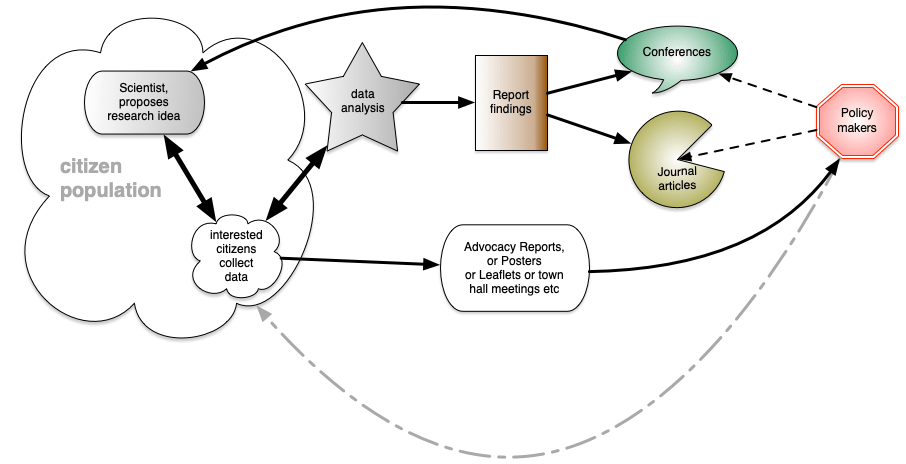
- Citizens might be the ones proposing the science to the scientists because they see a need. Or the scientists work with citizens to see how their expertise could affect that particular population.
- Citizens collect the data and share it with the scientists but the scientists also share any data summary, or manipulations, basically anything that they find is also shared (at some point) with the citizens too.
- The interested citizen group can also decide to do their own publication, or report, or communication strategy that is specifically aimed at informing the policy makers that affect these citizens directly. Notice that the aim of the research by the citizens is actually targeted directly at the policy makers. Previously the policy makers did not have such a direct channel.
Considerations or Problems with this Approach?
Like any partnership or relationship, the way that the relationship occurs needs to be negotiated. There probably needs to be time spent negotiating a ‘terms of agreement’ for things such as:
- Are the citizen’s allowed to use the data to influence policy makers before the scientists, given that scientist’s currency with regard to career or grant applications, tends to be based on original research publications?
- Do the scientists have the obligation or (even the right) to see what the citizen group is trying to promote with the data in order that they can ensure that the analysis conclusions from the collected data is correct?
Right now I do not see these as serious problems (at least not within our school and HUMI) as it feels very much as if we are all part of an extended, if somewhat diffuse team. I think it needs to be put on the radar but they seem like completely surmountable problems.
 HUMI Suva